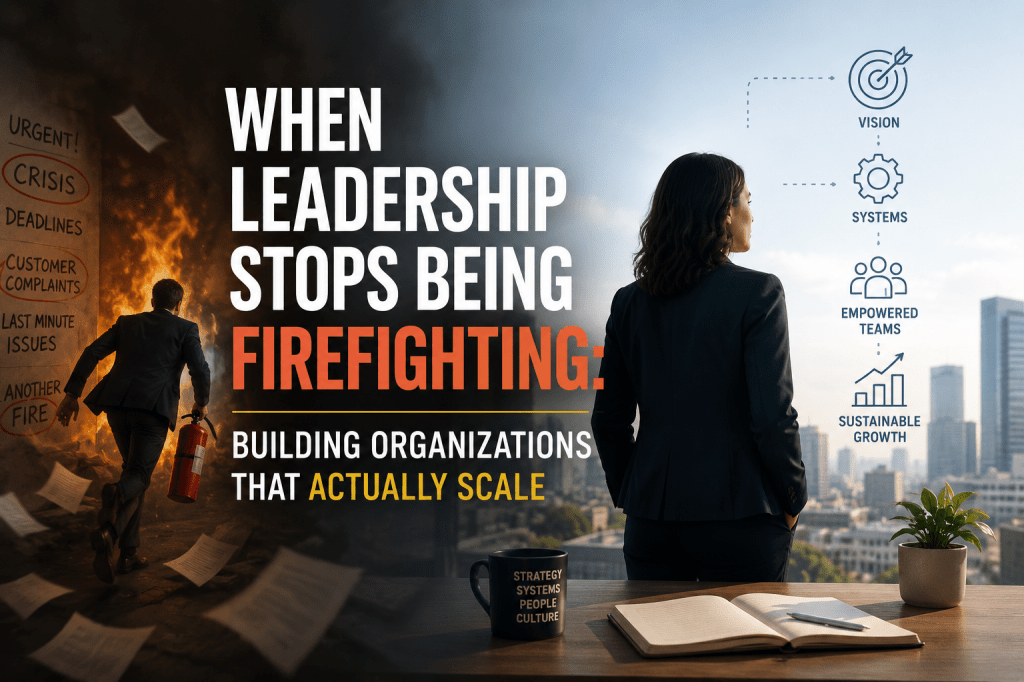
There is a pattern I have been noticing; not just in my own organization, but across teams, industries, and leadership conversations everywhere.
And it goes something like this:
Everything is urgent. Everyone is reactive. The team is constantly moving, constantly responding, constantly putting out fires. And from the outside; it looks like productivity. It looks like dedication. It looks like a high-performing team.
But from the inside? It feels like exhaustion wearing the costume of efficiency.
I know this pattern well. Because for a long time; I was running it.
The hidden cost of firefighting culture.
Here is what nobody tells you about reactive organizations: they can appear incredibly productive right up until the moment they collapse.
You can have talented people, strong work ethic, genuine commitment; and still be building something fundamentally unsustainable. Because when firefighting becomes the default operating mode; when urgency is normalized, when reactive execution is rewarded, when the team’s greatest skill becomes crisis management; you are not actually building an organization. You are just surviving one day at a time and calling it momentum.
After reviewing the patterns across our team huddles and leadership conversations at Move Supply Chain recently, something became very clear to me:
Our discussions had quietly evolved. We were no longer just talking about operational check-ins. We were talking about organizational scaling, strategic positioning, AI enablement, retention, leadership maturity, and sustainable systems.
That shift didn’t happen by accident. It happened because we started asking different questions.
Not just what do we need to fix right now? But what are we actually building? And is the way we are building it going to hold?
The transition every growing organization faces.
Every organization that survives its startup phase eventually arrives at the same crossroads.
On one side: continue operating as a fast-moving, reactive, execution-focused team. Keep doing what got you here. Keep firefighting. Keep moving fast.
On the other side: intentionally evolve into something more structured, more strategic, more scalable. Trade some of the speed for sustainability. Build systems instead of just solving problems.
At Move Supply Chain, we are in that transition right now. And I want to be honest about what that looks like from the inside; because I think a lot of leaders are navigating the exact same moment without a map.
We are moving from:
Phase 1: Fast-moving startup service provider
toward
Phase 2: Structured, strategic, scalable operations partner
That transition is uncomfortable. It requires letting go of habits that once served us well. It requires investing in infrastructure before it feels urgent. It requires saying no to things that are possible in the short term but unsustainable in the long term.
But it is absolutely necessary. And it is already underway.
The eight strategic shifts that are shaping our direction.
Based on everything I have been observing across our organization; here is where I believe the real leadership work lives right now. I’m sharing this not just as an internal reflection; but because I suspect these themes will resonate with leaders far beyond our industry.
1. Shift from reactive operations to sustainable systems.
Firefighting appeared repeatedly across our team discussions; overloaded resources, abrupt project changes, reactive execution, unstable structures. The strategic direction is clear: build redundancy in key functions, reduce dependency on hero-style execution, improve workload planning, and standardize transitions. The goal is not to eliminate challenges; it is to stop being surprised by predictable ones.
2. Move from volume-based acquisition to right-fit client strategy.
Not every account is worth taking. That is a hard truth for a growing organization to sit with; but it is an important one. When startup accounts carry the same operational pressure as larger ones at a fraction of the commercial value; the math simply doesn’t work long term. Defining your ideal client profile and establishing minimum commercial thresholds is not exclusivity; it is sustainability.
3. Upgrade reporting from status updates to strategic business intelligence.
There is a significant difference between telling your clients what happened and telling them what it means; what the risk is, what the opportunity is, what you recommend. Moving from task-based reporting to executive-level business intelligence is one of the fastest ways to reposition your organization from execution vendor to trusted strategic partner.
4. Embrace AI enablement as an operational advantage.
This was one of the strongest recurring themes across our huddles; AI dashboards, inventory systems, shipment trackers, AI-enhanced reporting. The organizations that will lead in the next five years are not the ones that resist these tools; they are the ones that integrate them thoughtfully, govern them well, and use them to reduce repetitive workload so their people can focus on higher-value thinking.
5. Protect team sustainability and wellbeing proactively.
This one is personal to me. An organization’s greatest asset is its people; and people are not machines. Maintaining workload caps, monitoring burnout signals early, avoiding underpriced accounts that drain resources; these are not soft decisions. They are strategic ones. A team that is well-rested, well-supported, and well-led will outperform a burned-out team every single time.
6. Build psychological safety into your leadership culture.
The best ideas in your organization will never surface if your people don’t feel safe enough to share them. Encouraging respectful disagreement, normalizing strategic conversations at every level, training leaders to escalate early rather than absorb silently; these things build the kind of trust that makes teams genuinely resilient rather than just apparently functional.
7. Systemize cross-functional integration.
Transitions, handoffs, onboarding dependencies, cross-team visibility; these were recurring friction points across our discussions. The solution is not more meetings. It is clearer ownership, standardized processes, better documentation, and an aligned operational cadence that doesn’t rely on tribal knowledge or individual heroics to hold together.
8. Evolve from execution team to strategic partner.
This is the overarching shift that all the others point toward. Your organization may already be operationally excellent. But operational excellence alone is a commodity. Strategic partnership; the ability to drive business direction, communicate impact, think commercially, and lead with recommendations rather than just execution; that is the differentiator. That is what earns you a seat at a different table.
What this means for leadership.
The biggest reframe this season has asked of me as Operations Director and COO is this:
My next leadership focus should not be more operational control. I already have that.
My next focus needs to be systemization and strategic maturity.
That means building scalable structures instead of just solving immediate problems. It means developing leaders who think strategically, not just managers who execute efficiently. It means creating an organization where the system itself carries the weight; not just the people in it.
And honestly; it means being willing to slow down long enough to build something that will actually last. Because if we are only moving fast without building wisely; we eventually become tired without becoming transformed.
There is a quiet wisdom in that; one that I think the best leaders across every industry are rediscovering right now. You cannot build a sustainable organization from a perpetual state of urgency. At some point; the most strategic thing you can do is pause, assess, and build with intention.
A final thought for the leader reading this:
If any of this resonates; if your team is exhausted, your systems are straining, your reporting is reactive, and your people are surviving more than they are thriving; this is not a failure of effort. It is a signal of transition.
You have outgrown Phase 1. And that is not a problem. It is progress.
The question now is whether you are willing to do the harder, slower, more intentional work of building Phase 2.
I believe you are. And I believe the organizations that make that shift deliberately; rather than waiting until the weight of the old model forces them to; will be the ones that define what excellent, sustainable, human-centered operations actually looks like in the years ahead.
That is what we are building at Move Supply Chain. And we are just getting started. 🌟
Is your organization in a similar transition? I’d love to hear where you are in the journey; connect with me in the comments or reach out directly. 🤍

 My Brightest Light
Leave a comment