There are moments in life that stop you completely.
Not the dramatic, cinematic kind of stopping where everything goes slow motion and the music swells. Just the ordinary, unremarkable kind; where you are sitting with your morning coffee, scrolling through your phone, and a name appears that you have not seen in years. And before you have even finished reading the message attached to it, something in you has already shifted. Something that had been quietly sitting in a corner of your chest, so long that you stopped noticing it was there, begins to loosen.
That happened to me recently. Twice, as it turns out. And I have been sitting with both experiences long enough now; turning them over, examining them from different angles, letting them settle; that I think I am finally ready to write about what they taught me.
The message I didn’t expect.
A former colleague reached out to apologize.
We had been genuinely close once; the kind of work friendship that is hard to explain to people who haven’t experienced it, because it exists in this particular intersection of professional trust and personal affection that doesn’t quite fit into either category neatly. We spent long hours together navigating the demands of a shared environment. I believed in him enough to recommend him for a senior position. I invested in his advancement because I genuinely wanted to see him succeed.
And then; as happens more often than any of us would like to admit; workplace politics entered the picture and quietly dismantled everything we had built. Disagreements that started as professional differences hardened over time into something more personal. Trust, once it begins to erode, tends to do so faster than you expect. By the time I left that job, the friendship was one of the quiet casualties I carried out with me; not loudly, not dramatically, but present nonetheless, like a dull ache you have learned to work around.
Years went by. I moved forward, built new things, invested in new relationships, and genuinely stopped thinking about it with any regularity. And then his message arrived; unhurried, honest, carrying no agenda that I could detect. Just a genuine acknowledgment of what had happened between us and a sincere expression of regret for his part in it.
I want to be honest about the full range of what I felt reading those words. There was surprise, certainly. There was a warmth I hadn’t anticipated. There was something that felt almost like nostalgia; a brief, bittersweet visit to a version of things that had once been good before they weren’t. But what struck me most deeply was a quiet sense of retroactive restoration. Of being seen; belatedly, imperfectly, but genuinely seen; in a situation where I had long since stopped expecting to be.
And I realized something I hadn’t known until that moment: I had still been carrying it. Quietly, without drama, folded into the ordinary fabric of moving on. But carrying it nonetheless. And I didn’t know that until it was lifted.
The leader who humiliated me in public.
His message also sent me back to an earlier memory; one I hadn’t visited in quite some time, but which returned with surprising clarity once I opened the door to it.
Early in my career, I was a young operations supervisor navigating one of the most chaotic and high-pressure work situations I had ever been part of. Things went wrong in ways that were systemic and widespread; the kind of failure that belongs to an entire organization rather than any single person.
In the middle of that chaos, a senior leader chose to make an example of me. Publicly. In front of colleagues whose respect I was still working to earn. The criticism was sharp and gave no consideration to the fact that what had gone wrong was far beyond the scope of what any young supervisor; still finding her footing; could have controlled or prevented.
I remember standing there and choosing to absorb it quietly rather than respond in kind. Not because I lacked the words, but because something in me understood that my character in that moment mattered more than my pride. What I could not have known then was how long that experience would stay with me; not as an open wound exactly, but as a kind of residue that settles into the way you carry yourself in professional spaces for years afterward.
What saved me in that season was a mentor; someone senior enough to have standing, generous enough to use it on my behalf, who stepped in and advocated for me when my immediate supervisor did not. I have never forgotten that. The experience taught me something I have tried to carry into every leadership role since: that the people around you are watching not just what you accomplish but how you treat the people beneath you when the pressure is highest. That is where character is actually revealed.
Years later, I crossed paths with that same leader at an industry event. I was not expecting anything beyond polite awkwardness. What happened instead was this: she apologized. Not defensively, not with qualifications designed to redistribute the responsibility, but with a straightforward honesty that I found genuinely disarming. She acknowledged that her behavior had been wrong. She said she was sorry.
I stood there and felt something unexpected. Not triumph; there was nothing to triumph over. Not even relief exactly. Just a quiet recognition that people are genuinely capable of growth; that the passage of time and the accumulation of experience can soften what was once rigid; and that humility, even when it arrives years late, still carries real weight.
What both of these moments taught me.
I have written on this blog before about forgiveness in the context of my personal life; my marriage, my family, the interior work that this past season has demanded of me. But forgiveness in professional contexts carries its own particular texture and weight, and I think it deserves its own honest conversation.
In the workplace we are often taught; through culture, through example, through the unspoken rules of professional conduct; that strength looks like imperviousness. That being good at your job means not letting things touch you. That you absorb the difficult moments, perform consistently regardless of how you feel, and leave whatever hurt was done to you at the door when you arrive the next morning.
But here is what I have learned after years of actually trying to live that way: we are human beings before we are professionals. The wounds that occur in work environments are real wounds. They leave real marks. The public humiliation does not disappear because you responded to it with composure. The betrayed trust does not dissolve simply because you continued showing up. These things settle into us, and pretending otherwise does not make us stronger; it just makes us heavier.
"Bear with each other and forgive one another if any of you has a grievance against someone. Forgive as the Lord forgave you." (Colossians 3:13)
That verse carries no professional exemption. It applies in every workplace, at every level, in every industry. It applies when a colleague you championed chooses politics over friendship, and when a leader uses authority to diminish rather than develop, and when the environment asks you; implicitly or explicitly; to be smaller than you actually are.
Forgiveness, I have come to understand, is not primarily a gift we extend to the person who wronged us. It is something we do for ourselves. It is the deliberate, sometimes costly decision to stop allowing someone else’s behavior from years ago to continue occupying space in our present. To stop letting the memory of a humiliation define how we walk into a room. To release the weight of an unresolved grievance so that we can move through the world more freely.
On holding your values when everything around you is shaking.
There is something else I want to say; particularly to anyone in a leadership role, or navigating a difficult professional season, or trying to figure out how to remain themselves when the environment around them is applying pressure to be someone else.
Your values are not situational. They are not something you maintain when it is convenient and set aside when the cost becomes real. The whole point of having values is that they hold when things get hard; when speaking up feels costly, when staying silent feels safe, when the path of least resistance is to look the other way and let something wrong continue unchallenged.
I have been in rooms where the pressure to compromise what I knew was right was immediate and significant. I have not always handled those moments perfectly. But I have learned, with enough time and enough reflection, that the decisions I can look back on with genuine peace are consistently the ones where I chose integrity over comfort.
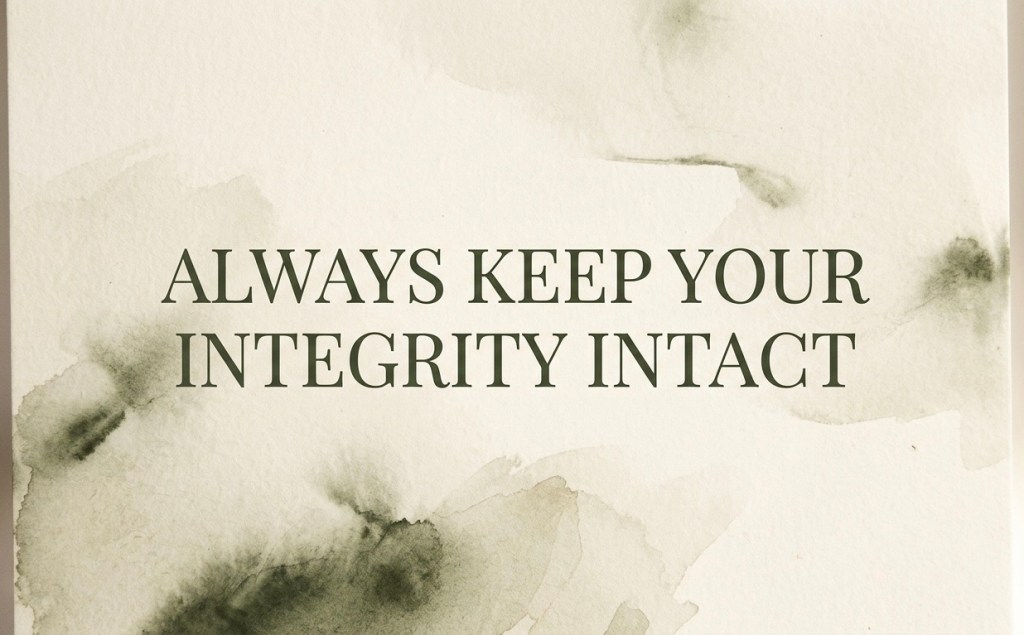
That conviction did not come from nowhere. It was planted in me very early by a mentor named Irma Diaz-Guevara; the first leader who truly believed in me when I was still a fresh graduate who had not yet given anyone much reason to believe. She was the first to see potential in me before I could see it clearly in myself. And the very first thing she ever said to me; the instruction I have carried in my chest through every professional season since, and that I now pass on deliberately to every mentee I have the privilege of walking alongside; was this:
“Claude, always keep your integrity intact. No matter what.”
Six words. Said once. Carried for a lifetime.
That is what a good mentor does. They do not just teach you skills or open doors for you. They hand you something to stand on when the ground gets shaky. And Irma gave me that before I even fully understood what it would cost me to honor it; or how grateful I would one day be that I did.
"Whatever you do, work at it with all your heart, as working for the Lord, not for human masters." (Colossians 3:23)
When you genuinely internalize that verse; when the primary audience for your work shifts from the approval of whoever happens to be in the room to something much larger and more permanent; the politics begin to lose their grip. The humiliation loses some of its power to define you. The pressure to perform at the cost of your character becomes something you can actually resist rather than simply endure.
You are more than your title. More than your performance metrics. More than whatever was said about you in your hardest professional moment. That has to be the ground you stand on; especially and most deliberately when everything else around you is uncertain.
A word about reaching out.
Both of the people in these stories chose to come back and make something right that had been wrong for a long time. That required courage; the particular courage of revisiting something painful and saying, without defensiveness or qualification, that you were wrong and that you are sorry.
I want to honor that. Because it is not easy. Pride is a persistent thing, and the longer time passes the easier it becomes to convince yourself that the window has closed; that too much time has passed, that the other person has moved on, that bringing it up again would only reopen something better left closed.
If there is someone in your professional life; or your personal life; with whom something remains unresolved, I want to gently suggest that the window is probably still open. That a sincere message sent with genuine intention and no expectation of a particular response can do more good than years of silence.
Life is too short and too full of unnecessary weight for things that could be resolved to remain unresolved.
For anyone navigating a difficult season at work:
Your character is being formed in the hard moments; not despite them. The way you respond when you are undermined, overlooked, treated unfairly, or asked to be less than you are says far more about who you are becoming than any performance review ever could.
Hold onto your values with both hands. Forgive when you are able; not because what happened was acceptable, but because you deserve to move through your life without that weight. Find your mentor; the person who can see your potential clearly on the days when you cannot see it yourself. And trust that the seasons which are forming you most right now are preparing you for something whose shape you cannot yet fully make out.
"And we know that in all things God works for the good of those who love him, who have been called according to his purpose." (Romans 8:28)
All things. Even the public humiliations. Even the friendships that broke under professional pressure and took years to find their way back toward healing. All of it working together, toward something genuinely good.
I believe that with increasing conviction the older I get and the more of this I have lived through.
And I am still, every day, learning to rest in it. 🌿
Has someone from your professional past ever surprised you with an apology or a moment of reconciliation? I would love to hear your story in the comments. 🤍


 My Brightest Light
Leave a comment